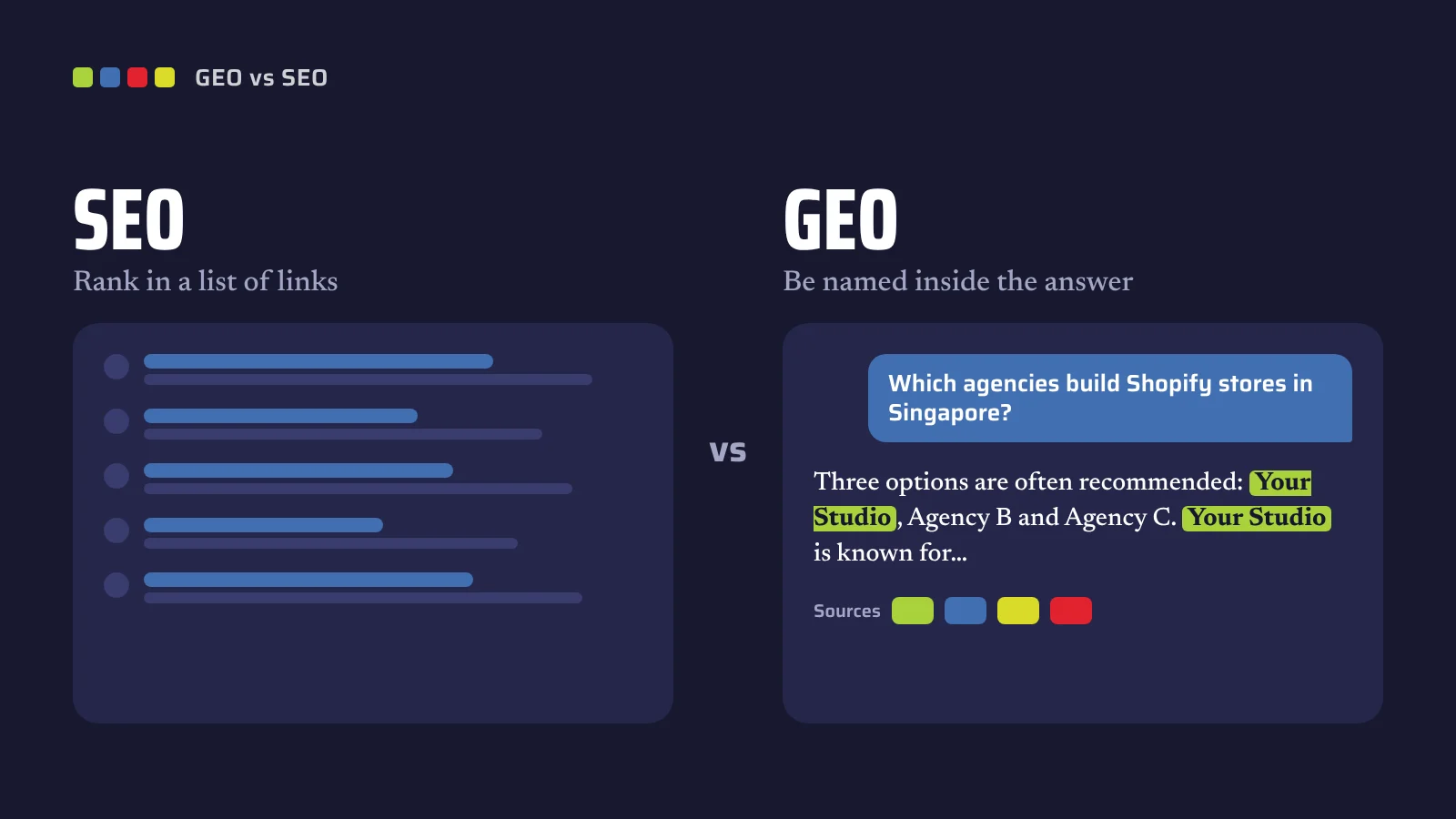
Buyers now ask an assistant before they open a search results page. “Which agencies in Singapore build Shopify stores?” “Who does Arabic SEO in Riyadh?” The answer is a short paragraph with three or four names. If yours is not one of them, you never get the click.
Generative engine optimization, or GEO, is the work of making your brand one of those names. The term comes from a 2023 research paper by researchers at Princeton and IIT Delhi, who found that changes to how content is written could raise its visibility in generated answers by up to 40% in their tests. The GEO vs SEO question is not either-or: GEO builds on SEO, and changes where you put the emphasis.
Check your own pages with our free AI visibility checker and AI crawler checker.
How GEO differs from SEO
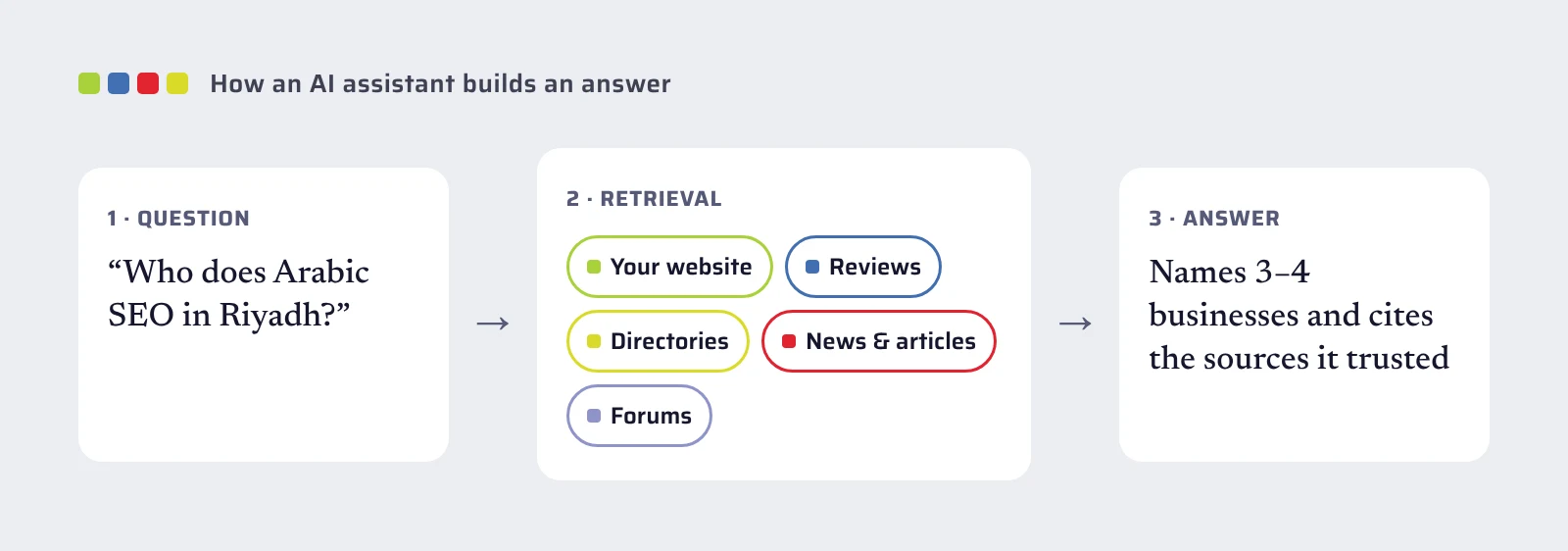
A search engine returns a ranked list of pages; an assistant returns a written answer that names a few businesses. SEO competes for the first, GEO for the second. They share foundations: a crawlable site, useful content and authority from other websites. The difference is in emphasis.
- Entities over keywords. Models need to understand clearly who you are, what you do and where. Inconsistent names, addresses and service descriptions across the web make that harder.
- Answers over pages. Content that states a clear answer near the top of the page is easier to quote than content that hides it under a long introduction.
- Third-party evidence. Assistants lean on reviews, directories, news coverage and comparison articles. What others say about you carries more weight than what you say about yourself.
| SEO | GEO | |
|---|---|---|
| Goal | Rank in search results | Be mentioned and cited in AI answers |
| Main unit | Page and keyword | Entity, answer and source |
| Key signals | Relevance, links, technical health | Consistency, clear answers, third-party mentions |
| Measurement | Rankings, clicks, conversions | Mentions, citations, share of answers |
Five things to fix first
- Measure your baseline. Write 20 to 30 prompts a buyer might use, run them in ChatGPT, Perplexity, Gemini and Google, and record who gets mentioned. Repeat monthly.
- Make your entity consistent. Use the same company name, description and service list on your site, LinkedIn, Google Business Profile, Clutch and any directory you appear in.
- Add structured data. Organization, Service, FAQPage and LocalBusiness schema help machines read your pages without guessing. Google’s introduction to structured data explains the formats.
- Rewrite key pages answer-first. Each service page should say in its first two sentences what you do, for whom and where.
- Earn mentions on pages assistants already cite. Look at which articles appear as sources for your prompts and work to get included in them.
Content that AI assistants like to cite
Assistants favour content that is easy to extract and clearly attributed: direct answers to specific questions, comparison tables, step-by-step guides, original data and FAQs. Pages with a named author or company, a date and clear sources are more trustworthy to both people and machines.
That does not mean writing for robots. The same qualities make content more useful to human readers, which is why GEO and good SEO content tend to look alike.
Technical basics for AI crawlers
Check that your robots.txt does not block the crawlers used by AI assistants if you want to appear in their answers (OpenAI, for example, documents its OAI-SearchBot and GPTBot crawlers), that important content is in the HTML rather than loaded only by JavaScript, and that your sitemap is up to date. An llms.txt file that summarises your business and links to key pages is a small, low-cost addition.
Does GEO replace SEO?
No. Most assistants retrieve live web results before answering, so pages that rank well are more likely to be cited. Google says the same in its guidance on AI features and your website: the usual SEO best practices still apply. Treat GEO as a layer on top of good SEO, not a replacement.
If you want a baseline report for your brand, start with our free AI visibility audit, or see our GEO service and SEO services.
Sources and further reading
- GEO: Generative Engine Optimization, Aggarwal et al., the paper that introduced the term
- AI features and your website, Google Search Central
- Overview of OpenAI crawlers, OAI-SearchBot and GPTBot
- The /llms.txt file, the proposal and format
- Introduction to structured data, Google Search Central
Frequently asked questions
What is generative engine optimization (GEO)?
GEO is the practice of improving how often and how accurately AI assistants such as ChatGPT, Perplexity, Gemini and Google AI Overviews mention and cite your business in their answers.
Is GEO different from AEO?
They overlap. Answer engine optimization (AEO) focuses on getting direct answers featured, while GEO focuses on generative AI answers. In practice, the same work improves both.
Does structured data help with GEO?
Yes. Organization, Service, FAQPage and LocalBusiness schema make it easier for search engines and AI systems to understand who you are and what you offer.
What is llms.txt?
llms.txt is a plain-text file at the root of a website that summarises the site and links to its most important pages for language models. It is a simple, low-cost addition.
How do I check if ChatGPT recommends my business?
Write the questions your buyers ask, run them in ChatGPT, Perplexity, Gemini and Google, and record who is mentioned. Repeat monthly to track changes.