“How much does a website cost?” has an honest answer: it depends, but not as much as agencies make it sound. Website development cost in 2026 falls into a handful of predictable ranges, and the price moves for reasons you can see in advance.
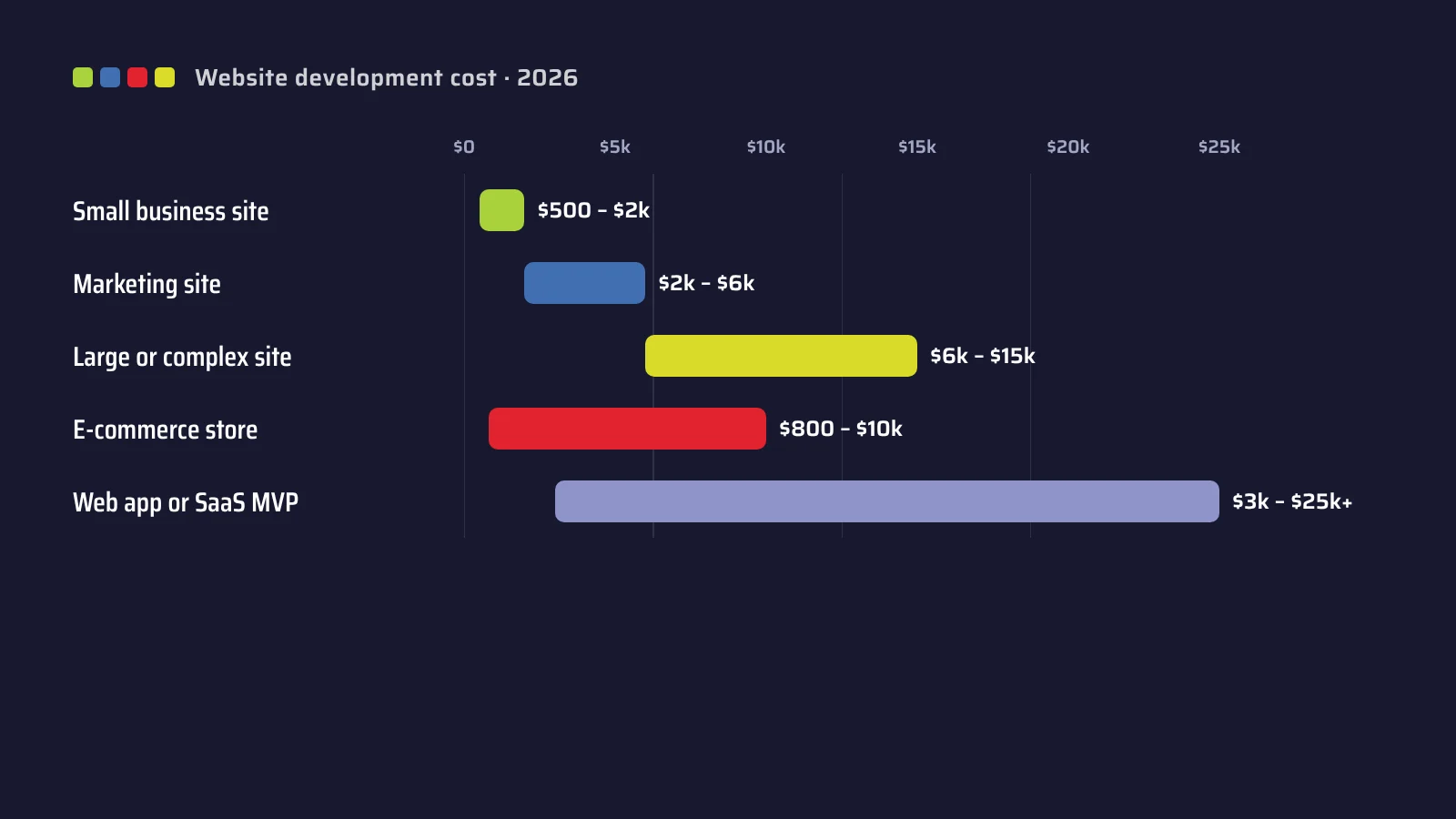
In short: a landing page or small business website can start from around $500, a larger marketing site typically costs $2,000 to $6,000, an e-commerce store $800 to $10,000, and a custom web app from $3,000 upwards. Content volume, integrations and how much custom design you need explain most of the difference. You can get a range for your own project in under a minute with our cost estimator.
Typical website development cost ranges
| Project | Typical budget | Typical timeline |
|---|---|---|
| Landing page or website up to 5 pages | $500 to $2,000 | 1 to 3 weeks |
| Marketing website, 5 to 20 pages | $2,000 to $6,000 | 3 to 6 weeks |
| Large or complex website | $6,000 to $15,000 | 6 to 12 weeks |
| E-commerce store | $800 to $10,000 | 2 to 8 weeks |
| Web app or SaaS MVP | $3,000 to $25,000 | 4 to 14 weeks |
These are indicative ranges for a senior team working from India for international clients. The lowest tier works best when you have your content ready and a proven template fits your brand. Local agencies in Singapore, Dubai or Western Europe typically charge several times more for comparable work.
What actually drives the price
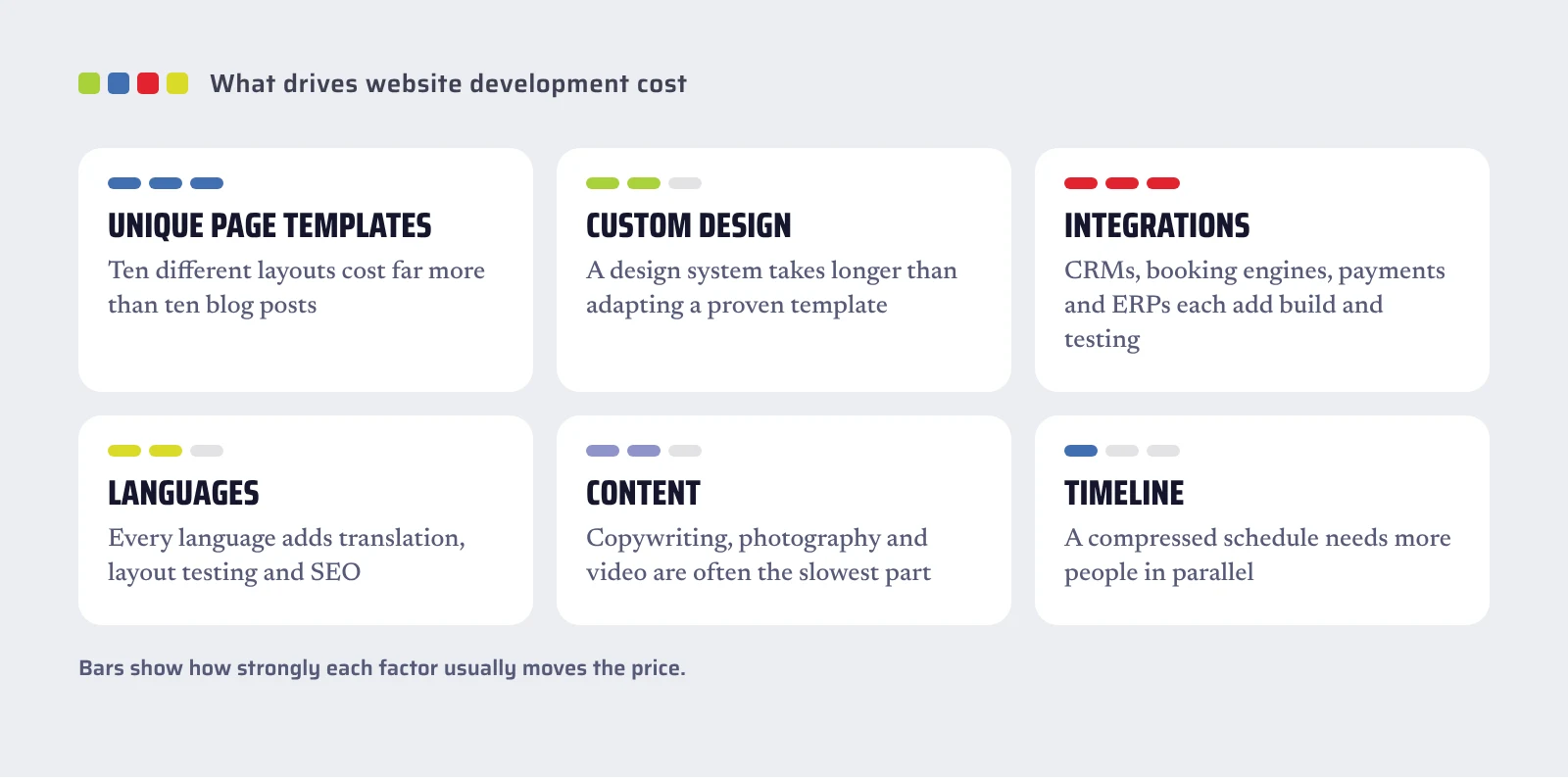
- Number of unique page templates. Fifty blog posts cost little more than five. Fifteen different page layouts cost a lot more than three.
- Custom design versus a proven template. A custom design system takes longer, but pays back if your brand needs to stand out.
- Integrations. CRMs, booking engines, payment gateways and ERPs each add design, build and testing time. A property website that pulls listings from a CRM, for example, needs data mapping, scheduled syncs and error handling.
- Languages. Every extra language adds translation, layout testing and SEO work, especially right-to-left Arabic.
- Content. If you need copywriting, photography or video, budget for it separately. It is often the slowest part of a project.
- Timeline. Compressing the schedule usually means more people working in parallel, which costs more.
Website cost by platform
WordPress remains the most common choice for business websites because editors know it and plugins cover most needs. Costs rise when a site relies on a heavy page builder and dozens of plugins, which also makes it slower and harder to maintain.
Static and headless builds on Astro or Next.js cost a similar amount for a marketing site, load faster and need less maintenance, but content editing depends on the CMS you pair them with.
Shopify is usually the fastest and most predictable way to launch a store, with monthly platform and app fees on top. Shopify’s own pricing page lists plans from $29 a month when paid yearly, plus card processing fees. WooCommerce has no platform fee, but hosting, security and plugin licences add up.
Custom web apps are priced on features and data rather than pages. User roles, permissions, payments and integrations are what drive the budget. See custom web app development for how we scope them.
Why speed is part of the price
A cheap site that loads slowly costs you twice: in lost enquiries and in rankings. Google measures real-user speed and stability through its Core Web Vitals, and you can check any page for free with PageSpeed Insights. Ask every agency for these scores on sites they have recently launched.
Costs people forget
- Hosting, domains and business email
- Paid plugins, themes and app subscriptions
- Stock photography, fonts and icon licences
- Ongoing maintenance and security updates
- SEO and content after launch: a site without a plan to grow it rarely pays back
How to brief an agency for an accurate quote
The more specific your brief, the narrower the quote. Include your goal (for example, more enquiries from a particular market), a list of pages or a sitemap, the integrations you need, who will write the content, the languages, a target launch date and two or three websites you like with a sentence on why.
If you do not know some of these yet, say so. A good agency will help you decide, and should separate a short paid discovery phase from the build if the scope is genuinely unclear.
How to avoid overpaying
Ask for a written scope with a fixed price, a list of what is excluded, and examples of similar projects the agency has shipped. If a proposal is a single number with no breakdown, ask for one. Check who owns the domain, hosting accounts and code, and make sure they are in your company’s name from the start.
Finally, compare total cost of ownership over two or three years, not just the build price. A cheap site on a bloated theme can cost more in fixes, plugin renewals and lost leads than a slightly more expensive site built properly.
For a real example of where integration work goes, see how we built a real estate website with Casafari CRM sync.
Ready for a real number? Tell us about your project and we will send a fixed quote, or read about our website design and development, e-commerce and WordPress services.
Sources and further reading
- Shopify pricing, current plan prices and card rates
- Web Vitals, Google’s guide to Core Web Vitals
- PageSpeed Insights, free speed test for any URL
Frequently asked questions
How much does a small business website cost in 2026?
A small business website of up to five pages typically costs $500 to $2,000 with a senior team working from India, and several times more with a local agency in Singapore, Dubai or Western Europe.
How much does an e-commerce website cost?
A Shopify or WooCommerce store on a customised theme starts from around $800. Custom designs with integrations to inventory, ERP or shipping systems typically cost $5,000 to $10,000 or more.
How much does website maintenance cost per month?
Basic care plans covering updates, backups and monitoring usually cost $30 to $150 a month. Plans that include content changes, SEO or new features cost more.
Is WordPress cheaper than a custom website?
Often, for content-heavy sites where a good theme fits. For speed-critical marketing sites, a lean custom build on Astro or Next.js can cost a similar amount and be cheaper to maintain.
Why do website quotes vary so much?
Quotes differ in scope, seniority and what is included. Compare written scopes, page templates, integrations, content, SEO and post-launch support, not just the total.
How long does it take to build a website?
One to three weeks for a small site, three to six weeks for a typical marketing site, and six to twelve weeks for large or complex sites.